

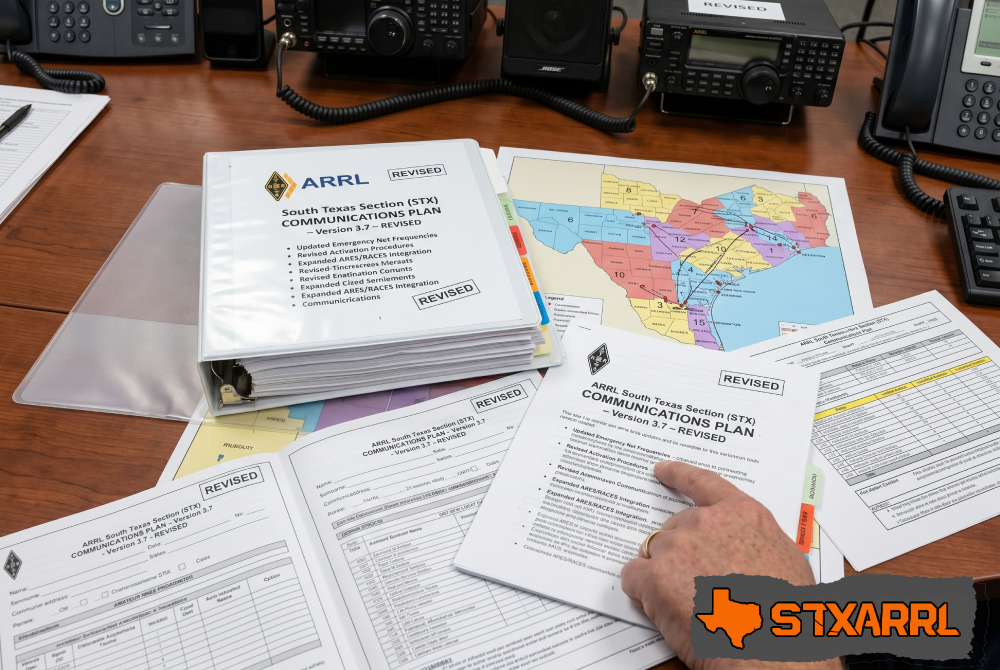

Amateur Radio Emergency Service
Emergency Communications Plan
1. Authority & 2. Purpose

1. Authority
The Amateur Radio Emergency Service® (ARES®) is sponsored by the ARRL, the national association for amateur radio, to fulfill the general responsibility of the Amateur Radio service to be prepared to provide communications in an emergency as defined in Federal Communications Commission (FCC) rules, 47 CFR 97.1.
ARES exists for the purpose of providing supplemental communications for the public, government and non-profit organizations involved in emergency and disaster preparedness, response and recovery. ARES is part of the ARRL field organization that reaches all 50 states, as well as Puerto Rico and other island protectorates, and territories. In the ARRL South Texas Section, ARES groups serve all 97 counties as well as other agencies that serve those counties.
The Section Manager (SM) is elected by the American Radio Relay League (ARRL) members in the section as their representative. The SM delegates their responsibility for administering and directing ARES within the section to an appointed Section Emergency Coordinator (SEC). In consultation with the SM, the SEC appoints District Emergency Coordinators (DEC) for multi-county districts, and Emergency Coordinators (EC) for counties or sub-divisions within counties. The SEC, DECs, and ECs are charged with developing, recruiting, training, leading and directing ARES members, developing emergency plans and relationships with served agencies within their geographic area as necessary to meet anticipated communications emergencies.
2. Purpose
This plan exists to provide general and specific guidance to the appointed leaders of the Amateur Radio Emergency Service (ARES) in meeting their responsibilities to develop, train, and direct ARES members in mitigating communications emergencies among public safety and disaster relief organizations within the ARRL South Texas Section.
3. Situation & Threats
3.1 Situation
3.1.1 General
The ARRL South Texas Section consists of 97 counties, covering nearly 96,000 square miles. It is approximately 525 miles east to west, and 450 miles north to south. It includes over 600 miles of coastline with the Gulf of Mexico, 450 miles of border with Mexico, and 60 miles of border with Louisiana. The geography includes thick forest, coastal plains, hill country, rivers and lakes. The population of over 11 million people is in large urban areas with high population density (Houston, San Antonio, Austin), and in counties with little population and low density. It includes the state capital in Austin, and several international seaports.
3.1.2 Climate
The climate across the section is a modified marine climate, classified subtropical, with four subheadings. A marine climate is caused by the predominant onshore flow of tropical maritime air from the Gulf of Mexico. The onshore flow is modified by a decrease in moisture content from east to west and by intermittent seasonal intrusions of continental air. The four Subtropical subheadings – Humid, Sub-humid, Semi-arid, and Arid – account for the changes in moisture content of the northward flow of Gulf air across the section.
- Eastern Third: Subtropical Humid climate, noted for warm summers.
- Central Third: Subtropical, sub-humid climate, characterized by hot summers and dry winters.
- Westernmost Third: Subtropical steppe climate, typified by semi-arid to arid conditions.
3.2 Threats
3.2.1 Extreme weather
The entire South Texas section can be affected by extreme seasonal weather conditions, including temperatures above 100 degrees during late summer, drought, abundant rainfall, high humidity, and mild winters with rare snowfall.
3.2.2 Weather threats
Weather threats include flooding, flash flooding, strong wind, ice storms, tropical storms, hurricanes, tornadoes, thunderstorms, severe thunderstorms, lightning, drought and extreme heat.
3.2.3 Technological threats
Technological threats include hazardous materials from both fixed facilities, such as the major petrochemical facilities in Pasadena, Corpus Christi, and Port Arthur, and from transportation incidents on interstate and state highways, railroads, urban, rural and suburban roads. Radiological incidents are possible from the South Texas Nuclear Project near Bay City, as well as the many medical and industrial uses of radioactive materials. Structure fires and wildfires claim 20-30 deaths each year in the counties of the South Texas Section.
3.2.4 Hostile individuals
Hostile individuals or groups may engage in terrorist acts any place that large groups of people gather; against private or government buildings, petrochemical, and other industrial sites; air, sea, rail, highway transportation and communications infrastructure. Materials employed can include conventional firearms, biological, nuclear, incendiary, chemicals, explosives, and improvised devices.
4. Concept of Operations
4.1 Agency assistance
When an agency asks the South Texas Section ARES for communications assistance, it gets the full benefit of the entire ARES organization. The ARES infrastructure includes privately-owned radios, antennas, ARES-dedicated and cooperating repeaters, and accessory equipment. Even more important than the equipment, the organizational structure includes numerous nets, training programs and exercises, and cooperative planning with agencies to learn their needs, and the services of scores of trained operators, few of whom are visible at the disaster site.
The ARES field organization is designed to support as fully as possible, upon request, any and all emergency response and disaster relief organizations. In doing so, ARES retains its own identity and organizational structure, personnel and physical infrastructure while providing communications support.
Officials of emergency and disaster response agencies who desire ARES assistance should contact the closest ARES leader to the incident or disaster, usually an EC or DEC. The EC or their designated representatives are the only persons who may authorize the activation of the registered ARES members in their area. Officials may also contact the SEC, the Assistant SEC (ASEC) for Operations or the Section Manager.
4.2 ARES Member Response to Actual or Potential ARES Need
When any ARES member becomes aware of an actual or potential need for ARES, all effort should be made to contact the responsible EC or an Assistant EC. Only when an EC or delegated representative cannot be contacted in a reasonable time should the DEC or SEC be contacted.
Once the EC, DEC, or SEC has been notified, ARES members should monitor their local resource net, or the Texas ARES HF net, for more information and instructions.
ARES members are prohibited from self-deploying.
4.3 Communications Emergencies
Communications emergencies take two general forms: systems either fail or are otherwise inadequate for the immediate needs. System failure can be caused by hardware (physical equipment, electrical or interconnecting lines) or software. Inadequacy can mean the existing infrastructure is inadequate to handle the information volume, or the organizations responding to an incident have unanticipated communications needs, such as communicating with non-traditional services.
4.4 Amateur Radio as a Force Multiplier
During critical events, amateur radio is being increasingly used as a “force multiplier” to extend limited public service resources even when existing communication systems are fully operational. An example is stationing amateur radio operators along a rising river to report gauge readings instead of stationing police resources there. Using SKYWARN trained amateurs to qualify weather reports is a second example.
4.5 ARES Response
ARES leaders identify the communications needs and priorities of the served agencies, then assign and direct ARES resources to address that need. ARES ECs and DECs should avoid accepting operating assignments so that they remain available to coordinate ARES resources.
Staffing priority in any emergency incident will be given first to those who are registered with ARES. Lower priority will be amateur radio operators not associated with any ARES group. Assignments will be made to minimize the travel distance.
ARES members are prohibited from traveling to the site of any emergency incident beyond their immediate area unless authorized to do so by an EC, DEC, SEC, or their designated representative, such as the net control station of a resource net. ARES members will only be authorized to go to the site of an emergency incident after the appropriate served agency requests ARES help at that site.
4.6 ARES Member Safety
Safety First: If any requested action involves unacceptable risk, the person should NOT take the action. Upon refusal, the person should notify the net control station that they will not be performing the requested action, along with a brief statement of their risk assessment. There is not any ARES assignment which is so important that it cannot be done safely.
5. Organization & Districts
The 97 counties in the South Texas Section are divided into fourteen (14) ARES districts as follows. The SEC may appoint District Emergency Coordinators (DEC) and Emergency Coordinators (EC) as needed to effectively organize ARES activities and groups within these districts and counties. Maximum effort should be made to appoint ECs for counties with over 50,000 in population. ARES members are under the direction of Assistant ECs, the EC, DECs, and the SEC.
South Texas ARES Districts
5.2 Training Requirements
ARES leaders are expected to complete the following training classes, prior to or as soon after their appointment as possible: FEMA IS-100, IS-200, IS-700, and IS-800. See Appendix A for more details of the courses.
5.3 EC Authority
Emergency Coordinators may appoint, and cancel the appointment of, Assistant ECs as necessary. It is recommended that these appointments be given the titles and duties as described by the Incident Command System (ICS) for general staff positions.
5.4 Daily Situation Reports
Upon activation of an ARES group by its leaders, the EC or representative should send a short situation report to their DEC not less than once daily. DECs should consolidate EC reports and send one to the SEC each day of the ARES activation based on a schedule determined for the incident. By citing only the line number, this can be passed in radiogram format:
1. INCIDENT TYPE: brief description
2. REPORTING PERIOD
3. SUPPORTED CLIENTS & LOCATIONS: brief description
4. NUMBER OF ARES OPERATORS
4a. Currently committed:
4b. Contacted:
4c. Additional needed:
5. SUMMARY OF OPERATIONS
6. REPORT BY: name, callsign, county
5.5 Mutual Aid response levels
| Response Level | Description | Action & Coordination |
|---|---|---|
| Level 1 | Primary group has sufficient resources. | Handled locally by registered/spontaneous local volunteers. |
| Level 2 | Resources insufficient in primary county. | EC contacts ECs of adjacent counties, identifies needs, and informs the DEC (or SEC/SM if unreachable). |
| Level 3 | Primary county and district resources insufficient. | DEC contacts DECs of adjacent districts, identifies needs, and informs the SEC (or ASEC/SM if unreachable). |
| Level 4 | Section resources insufficient. | DEC contacts SEC/SM. Resources are coordinated from outside the South Texas Section. |
6. Readiness Conditions
Most emergencies follow some recognizable build-up period during which actions can be taken to achieve a state of maximum readiness. These readiness conditions are used as a method of increasing the alert posture of ARES members. The current readiness condition may be found on the ARRL STX Website.
ARES Leaders Actions
- Maintain contact on the state ARES HF net at 7:30 PM each Monday evening.
- Establish relationships with potential ARES clients.
- Organize, recruit and train ARES members.
ARES Members Actions
- Take suggested FEMA courses, participate in public service events, nets, and meetings.
- Program radios with ARES frequencies.
- Verify equipment readiness on a monthly basis.
- Participate in local training nets and enjoy amateur radio.
Triggered by potential threats with no immediate danger to life/property (Hurricane/Tornado/Flash Flood Watch, High Wind expected 39+ MPH).
ARES Leaders Actions
- If activated, maintain contact on the state ARES HF net at 7 PM each evening.
- Participate in local nets and review the emergency communications plan.
- Contact potential clients and notify members that activation is possible.
ARES Members Actions
- Review family emergency plan.
- Refresh food, water, and clothes in go-kits.
- Check or charge HT and storage batteries weekly; carry HT at all times.
- Keep vehicle fuel tank more than half full.
Triggered by severe weather warnings (Inland Hurricane, Tornado, Flash Flood, or Winter Storm Warning).
ARES Leaders Actions
- If activated, maintain contact on the state ARES HF net at 7 PM each evening.
- Prepare operator schedules for key clients, operations, and resource nets.
- Activate a resource net.
- Conduct daily meetings/conference calls with ARES leaders.
- Notify members that activation is expected or imminent.
ARES Members Actions
- Monitor ARES repeaters.
- Secure home, family, and emergency supplies.
- Top off vehicle fuel tank.
- Place go-kits and batteries in vehicle.
Triggered by active severe weather or actual emergency conditions (Tornado sighted moving to populated area, major active flooding, etc.).
ARES Leaders Actions
- Maintain continuing contact on the state ARES HF net.
- Activate local operations nets.
- Send daily situation reports to the DEC/SEC.
- Forward reports to the Communications Coordination Group (CCG) when active.
ARES Members Actions
- Follow the direction of ARES leaders or delegated representatives (like Net Control).
- Send daily situation reports to SEC (with copy to CCG) if acting as part of Level 3/4 Mutual Aid or Texas Rapid Response Task Force.
7. Frequencies & Digital Messaging
7.1 Section Emergency Frequencies
7285 kHz
7290 kHz
3873 kHz
3935 kHz
7.2 Digital Messaging
Digital networks provide automated error-free transfer of logs, checklists, forms, and messages. The following systems are recommended:
- HF Digital National Traffic System: Recommended for NTS-type message routing without email addresses.
- Winlink System: Recommended for destinations with email addresses. Supports HF and VHF with Winlink Express. sound card software VARA HF/FM is much faster than legacy protocols and is the preferred mode.
- Point-to-Point Digital: VARA/PACTOR simplex center frequencies for use inside the section are 3591.5 kHz and 7091.5 kHz (Dial: 3590.0 / 7090.0 kHz).
- APRSLINK: Limited capacity option for areas with active APRS iGATEs and no local RMS packet gateways.
7.3 Internet Outage Operations (RF-Only mode)
In a complete Internet outage (e.g. cyberattack), the section will designate a Winlink HF server configured to operate in an RF-only mode to act as the central message hub for the section. The N5TW station is the default central hub.
Additional HF peer-to-peer relay stations will manually forward traffic to this central hub using Winlink packet, VARA, or PACTOR. Frequencies and reply traffic routing are managed via the HF voice net.
7.4 Infrastructure Requirements by District Size
- Districts over 250,000 population: Minimum of two VHF/UHF RMS Packet/VARA FM Internet gateways. All counties with an EC should have at least one station capable of contacting a Winlink node.
- Districts over 1,000,000 population: Minimum of four RMS Packet/VARA FM stations, and are encouraged to run RMS Relay with HF Pactor 3/VARA HF forwarding in hardened locations with backup power.
Appendices & Section Contacts
Appendix A: Amateur Radio Communications Teams (ARCTs)
ARES operators participating in communications response teams (CRTs) or mutual assistance teams (MATs) must pre-qualify according to resource types:
| Resource Type | Required Radio Capability | Data & Mode Capabilities |
|---|---|---|
| Type 4 | Voice on 2 Meters and 70 Cm bands. | Voice only. |
| Type 3 | Voice on 2 Meters, 70 Cm, and HF bands. | Voice only. |
| Type 2 | Voice on 2 Meters, 70 Cm, and HF bands. | VHF/UHF Packet, VARA FM, and HF Winlink (VARA/Pactor 2). |
| Type 1 | Voice on 2 Meters, 70 Cm, and HF bands. | VHF/UHF Packet, VARA FM, and HF Winlink (VARA/Pactor 2/3). |
Appendix B: Digital Message Network Guidelines
- Message Numbers: All messages must be uniquely numbered when originated, and this number preserved in all replies. Final recipient full name must appear in the Subject line.
- Off-line Composition: Compose and read messages off-line to minimize channel occupancy. Listen to the frequency before connecting to avoid interference.
- Attachments: Keep attachments as small as possible. Use plain text, RTF, or CSV formats.
- RMS Packet Stations: Run Windows 10 or later on UPS power. Use VARA FM sound card protocol alongside legacy packet.
- EOC separate setups: Separate voice and digital radio/antenna setups are strongly recommended to avoid interference.
Appendix C: ARES Section Contacts
Houston, TX 77040
Phone: 281-467-8595 (Cell)
Email: ke5fga@arrl.net
Georgetown, TX 78628
Phone: 512-863-6865
Cell: 512-924-1573
Email: n5tw@arrl.net
Austin, TX 78756
Phone: 512-660-9954 (Cell)
Email: kf5nix@arrl.org
Newington, CT 06111
Phone: 860-594-0200
FAX: 860-594-0259
Email: hq@arrl.org
Communications Coordination Group (CCG) Email: KT5CCG@Winlink.org (Non-Winlink emails must include //WL2K/ in the subject).
Note: A complete “South Texas ARES Leaders” contact list is maintained in the www.arrlstx.org Document Vault.